 comparison
Accessibility Partners vs EqualPath: Which Partner Wins?
Table of Contents
- Accessibility Partners vs EqualPath: Quick Comparison
- Accessibility Partners: Strengths and Limitations
- EqualPath: Strengths and Limitations
- Manual vs Automated Accessibility Testing: What Each Partner Offers
- AODA Compliance for Small Business: Which Partner Fits?
- Website Accessibility Compliance Services Compared
- Where Each Partner Wins: A Decision Framework
- Frequently Asked Questions
Last Updated: September 13, 2026
Accessibility Partners vs EqualPath: Quick Comparison
Choosing between accessibility partners and EqualPath comes down to one question: do you need commercial website remediation, or institutional education-sector consulting? Accessibility Partners is a full-service consultancy built for AODA and WCAG compliance work on commercial sites. EqualPath focuses on educational accessibility and support for underrepresented students.
Accessibility Partners handles technical audits, manual testing, and formal compliance documentation. EqualPath handles strategic planning for schools and non-profits. If your website fails WCAG 2.2 AA, Accessibility Partners is the fit; if you need an institutional accessibility program, EqualPath is.
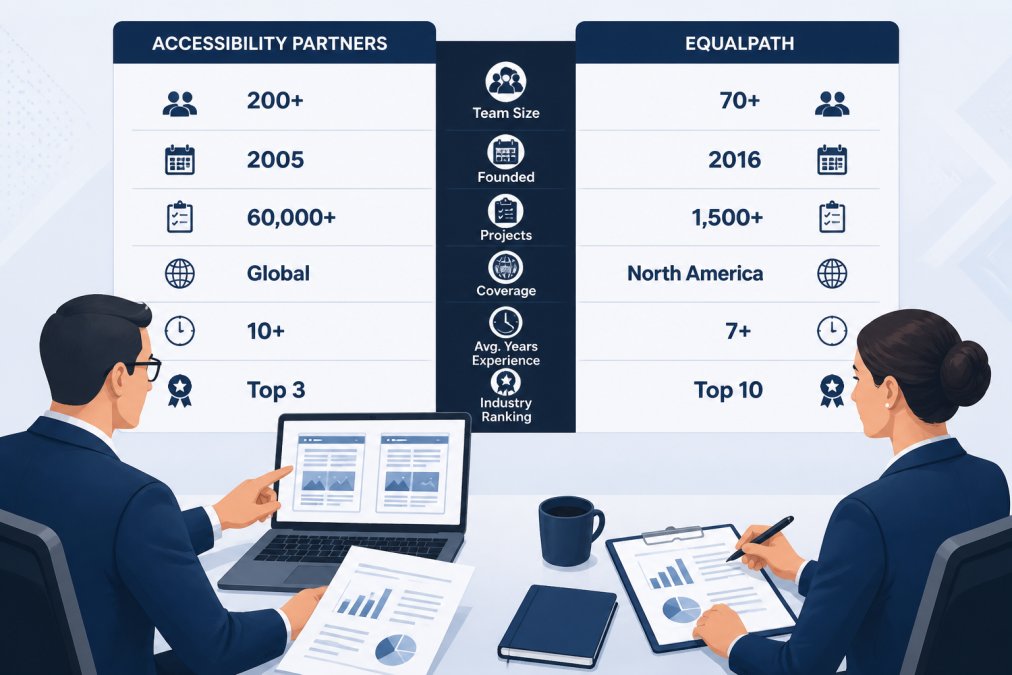
| Criteria | Accessibility Partners | EqualPath |
|---|---|---|
| Primary focus | Commercial web compliance | Educational accessibility |
| Testing approach | Manual, WCAG 2.2 AA | Program and policy consulting |
| Documentation | VPAT and ACR support | Institutional planning |
| Best for | Businesses needing audits | Schools and non-profits |
Accessibility Partners: Strengths and Limitations
Accessibility Partners provides accessibility testing, auditing, and compliance support for AODA and WCAG standards. Its model centres on manual testing rather than automated-only scans, which matters because automated tools catch only part of the barriers real users hit.
Where Accessibility Partners Excels
Its deepest strength is regulatory fluency: teams working through formal compliance documentation, including VPAT and ACR development, get a partner that has done this work repeatedly. Disability-inclusive consulting and training round out the offer, helping internal teams build lasting habits rather than patching issues once.
Where Accessibility Partners Falls Short
Pricing is the friction point: Accessibility Partners does not publish rates and requires direct consultation before any numbers surface, which slows budget planning. The other limitation is scope, this is a commercial compliance shop, so an educational institution seeking student-focused program design will find the fit awkward.
EqualPath: Strengths and Limitations
EqualPath is a specialized consultancy focused on educational accessibility and institutional support for underrepresented students. Engagements are structured strategy first, compliance second.
Where EqualPath Excels
Niche expertise is the differentiator. Strategic planning for educational accessibility, inclusive design consulting for academic environments, and advocacy program development are all built around how institutions actually operate. Non-profits and schools get a partner that understands funding cycles, governance, and student-facing obligations.
Where EqualPath Falls Short
The specialization cuts both ways. EqualPath is not designed for general commercial website remediation, so a business with a failing checkout flow or inaccessible product pages will not get the source code fixes it needs. Pricing is also consultation-based, with no published rates.
Manual vs Automated Accessibility Testing: What Each Partner Offers
Manual testing catches what automated scanning misses, and that distinction separates these two firms. Accessibility Partners builds its practice around manual testing, which surfaces keyboard navigation failures, screen reader conflicts, and semantic HTML gaps that scanners report as clean.
Automated scanning is fast, repeatable, and useful for catching regressions across large sites. What it cannot do is judge whether alt text makes sense to a person, whether focus order follows the visual flow, or whether a custom widget announces its state correctly to a screen reader. Treating a clean automated report as proof of compliance is a common mistake.
WCAG 2.2 AA success criteria are largely outcome-based, they describe what a user must be able to do, not what the markup must contain, and automated rules can only test what is machine-verifiable. Most practitioners find automated tooling reliably catches roughly a third of common issues, with the rest requiring a human to operate the interface. That ratio is why a defensible audit pairs both: automated passes for coverage and regression detection, manual passes for judgment.
EqualPath approaches testing differently: its work sits earlier in the process, in program design and policy, so testing methodology is less central. For a defensible audit with documented manual testing, Accessibility Partners is the stronger choice; for building testing into an institutional workflow, EqualPath's planning work sets that foundation.
Where testing methodology meets the development pipeline
An audit is a snapshot; a pipeline is a process. If your team ships code weekly, a one-time manual audit starts decaying the moment the next pull request merges. The durable answer is to wire automated checks into continuous integration so every commit is scanned before production, then reserve manual testing for new components, interactive widgets, and periodic full-site sweeps.
That split matters for vendor selection. Accessibility Partners' model is built around the periodic audit and its documentation, valuable for procurement and regulatory proof, but not designed to live inside your CI/CD workflow. EqualPath's model is upstream of code entirely. Neither firm's published offering describes pipeline integration, so organizations needing continuous enforcement usually buy the audit from one vendor and build the automation in-house.
A practical sequence for most teams:
- Commission a manual audit to establish a baseline and produce documentation.
- Remediate the findings at the source code level.
- Add automated checks to the build pipeline so regressions fail the build.
- Re-run manual testing on a fixed cadence and whenever a new component type ships.
Post-remediation maintenance: the piece nobody scopes
Testing methodology and maintenance are the same conversation. A site that passes a full manual audit in month one can fail by month six once new content ships without alt text, a template is updated with a deprecated pattern, or a third-party widget is added. Compliance is not a state you reach; it is a condition you maintain.
That is the strongest argument for treating testing as an ongoing line item rather than a project. Budget for a recurring audit cadence, assign an internal owner for accessibility in code review, and keep a living record of known exceptions so a future auditor is not starting from zero. Organizations that skip this tend to pay for the same remediation twice.
AODA Compliance for Small Business: Which Partner Fits?
AODA compliance for small business is where the choice gets practical. The Accessibility for Ontarians with Disabilities Act sets requirements for organizations operating in Ontario, and obligations scale with organization size. Smaller firms often need targeted remediation on a defined set of pages rather than an enterprise-wide program.
Accessibility Partners fits when you need formal documentation to show a regulator, a procurement team, or a client that your site meets WCAG 2.2 AA. The firm's AODA support and VPAT work are built for exactly that scenario.
EqualPath fits a narrower case: a small non-profit or educational organization that needs help shaping an accessibility program rather than fixing a website. If your AODA obligation is about your public-facing site, EqualPath is not the match.
For current requirements and timelines, check the Ontario government's AODA compliance guidance directly, since obligations depend on your organization type and size.
Website Accessibility Compliance Services Compared
Website accessibility compliance services fall into three buckets: audit-only, audit plus remediation, and ongoing program support. Knowing which you need narrows the vendor list fast.
Accessibility Partners covers audit and documentation thoroughly, with manual testing at the core. Its limitation is that the published information does not detail source code remediation depth, so confirm that scope during consultation.
EqualPath covers program support for institutions. Remediation of commercial source code is outside its stated focus.
The wider market includes firms with different models. Allyant offers end-to-end remediation plus document accessibility for PDFs and digital files, which suits agencies needing a long-term partner. DigitalA11y publishes transparent per-page pricing, which helps small firms budget without a sales cycle. TestPros specializes in independent third-party verification, useful when you need objective validation rather than a vendor grading its own work.
| Provider | Model | Best For |
|---|---|---|
| Accessibility Partners | Manual audit and documentation | Formal compliance proof |
| EqualPath | Institutional consulting | Schools and non-profits |
| Allyant | End-to-end remediation | Agencies needing scale |
| DigitalA11y | Per-page pricing | Budget-conscious small firms |
| TestPros | Third-party verification | Objective compliance validation |
The cost-benefit math most buyers never run
Service lists tell you what a vendor does, not whether the engagement pays for itself. A simple framework helps decision-makers justify the line item.
Start with the cost of inaction. For an organization operating in Ontario, a non-compliant public-facing site carries exposure under the Accessibility for Ontarians with Disabilities Act, and the practical cost shows up in three places: remediation that gets more expensive the longer it is deferred, lost procurement opportunities where accessibility conformance is a scored requirement, and internal time spent fielding complaints and re-auditing. Add those three and compare them against a structured engagement.
Then weigh the engagement against doing it in-house. An internal effort needs someone who knows WCAG 2.2 AA well enough to interpret success criteria, time carved out of a development roadmap, and a testing process that survives staff turnover. Most teams underestimate the interpretation cost, knowing a criterion exists is different from knowing how it applies to a custom component.
Finally, look at the shape of the spend. A one-time audit is a capital expense with a short shelf life; a partnership with a recurring cadence is closer to insurance, predictable cost, continuous coverage, and a documented trail that holds up under procurement scrutiny. A brochure site that ships twice a year needs the audit; a product site that ships weekly needs the partnership.
Legal risk mitigation beyond compliance
Meeting a standard and reducing legal exposure are related but not identical goals. The difference is documentation quality and independence.
A conformance report that overstates your position creates more risk than no report at all, because it establishes a written record that can be contradicted. That is why the methodology matters as much as the report: manual testing with a documented process, findings tied to specific success criteria, and a clear statement of what was tested and excluded. Independent third-party verification adds credibility a self-assessment cannot.
For organizations facing procurement scrutiny or public-sector contracts, the practical move is to pair remediation with verification from a party that did not do the fixing. It costs more and it is worth it when the document is going to be relied on.
Post-remediation maintenance
One gap most buyers miss: none of these engagements fix accessibility permanently. Code changes get overwritten, content gets added without alt text, and new templates ship with old problems. Post-remediation maintenance keeps a site compliant after the invoice is paid.
A workable maintenance model has four parts: automated checks in the build pipeline that fail on regressions, a named internal owner for accessibility in code review, a recurring manual audit on a fixed cadence, and a living exception log so known issues are tracked rather than rediscovered. Organizations that build this into the original engagement spend less over three years than those that re-commission a full audit every time something breaks.
W3C's Web Content Accessibility Guidelines remain the technical benchmark both firms work against, and Accessibility Standards Canada publishes federal guidance worth reviewing if you work with public sector clients.
Where Each Partner Wins: A Decision Framework
Use this framework to pick without a sales call.
Choose Accessibility Partners if: you need a WCAG 2.2 AA audit with manual testing, formal VPAT or ACR documentation, and AODA compliance support for a commercial website.
Choose EqualPath if: you are an educational institution or non-profit building an accessibility program, and your need is strategic planning rather than code-level remediation.
Choose neither if: your requirement is ongoing remediation tied into your development pipeline. Neither firm's published model covers CI/CD integration, where accessibility checks run automatically on every code commit. That is where technical debt accumulates fastest.
Consider the wider market if: you need transparent per-page pricing or independent third-party verification.
W3C's Web Content Accessibility Guidelines remain the technical benchmark both firms work against, and Accessibility Standards Canada publishes federal guidance worth reviewing if you work with public sector clients.
Most organizations do not fail at accessibility because they picked the wrong consultant. They fail because remediation stops when the project ends. Accessibility Partners and EqualPath both do solid work within their lanes, but neither model is built to keep a commercial site compliant after launch, and that is the gap that costs money.
Elevated Digital exists for that gap. We provide defensible website remediation, seamless system integration, and measurement that shows what actually changed. If your team already works with another compliance vendor and needs the technical fixes done properly, we handle the remediation and give you results you can take to your CFO. Get started with Elevated Digital and build a digital presence that withstands scrutiny.
Frequently Asked Questions
Is WCAG 2.1 a legal requirement in Canada?
WCAG 2.1 is not directly legislated in Canada, but it underpins provincial standards like the Accessibility for Ontarians with Disabilities Act (AODA), which requires WCAG 2.0 Level AA. Many organizations now aim for WCAG 2.2 because it adds criteria for motor and cognitive disabilities. Accessibility Partners and EqualPath both reference WCAG in their audits, but only Accessibility Partners explicitly advertises WCAG 2.2 AA support. Confirm the exact version your compliance obligations demand before signing a contract.
What are the primary differences between automated and manual accessibility testing?
Automated scanning catches roughly 30 percent of accessibility issues, such as missing alt text or poor colour contrast. Manual testing, performed by people using screen readers and keyboard navigation, uncovers the rest: illogical tab order, unclear link text, and dynamic content failures. Accessibility Partners emphasizes manual testing, while EqualPath leans on a mix of strategic consulting and inclusive design reviews. For a defensible audit, demand both methods, plus user testing with assistive technology.
What should small firms look for in a website remediation partner?
Look for transparent pricing, a clear remediation roadmap, and post-remediation maintenance. Accessibility Partners does not publish rates, which can complicate budgeting for small firms. EqualPath targets educational and non-profit clients, so commercial remediation may not be its core focus. Ask whether the partner will fix source code directly or hand you a report, and whether they offer ongoing monitoring. A partner who only tests, without fixing, leaves your team with technical debt.
Are accessibility overlays a viable alternative to professional remediation?
Overlays are automated widgets that attempt to fix accessibility on the fly. They do not address source code problems, and they can conflict with assistive technology. Neither Accessibility Partners nor EqualPath promotes overlays as a substitute for remediation. If a vendor offers an overlay as your primary compliance solution, treat it as a red flag. Genuine barrier removal requires semantic HTML, keyboard navigation fixes, and source code optimization, not a script layered on top.
How do accessibility consultants ensure compliance with provincial standards?
Consultants map your website against the relevant standard, such as AODA's Integrated Accessibility Standards Regulation, then test against WCAG success criteria. They produce a VPAT or accessibility conformance report, document remediation steps, and retest after fixes. Accessibility Partners builds formal compliance documentation into its engagements. EqualPath focuses on institutional accessibility planning. Whichever partner you choose, request a sample compliance report and confirm they track regulatory requirements beyond a one-time audit.